Live-In Care in Carlisle: When You Need More Help, Why Should You Have to Leave Home?
Live-In Care in Carlisle: When You Need More Help, Why Leave Home?
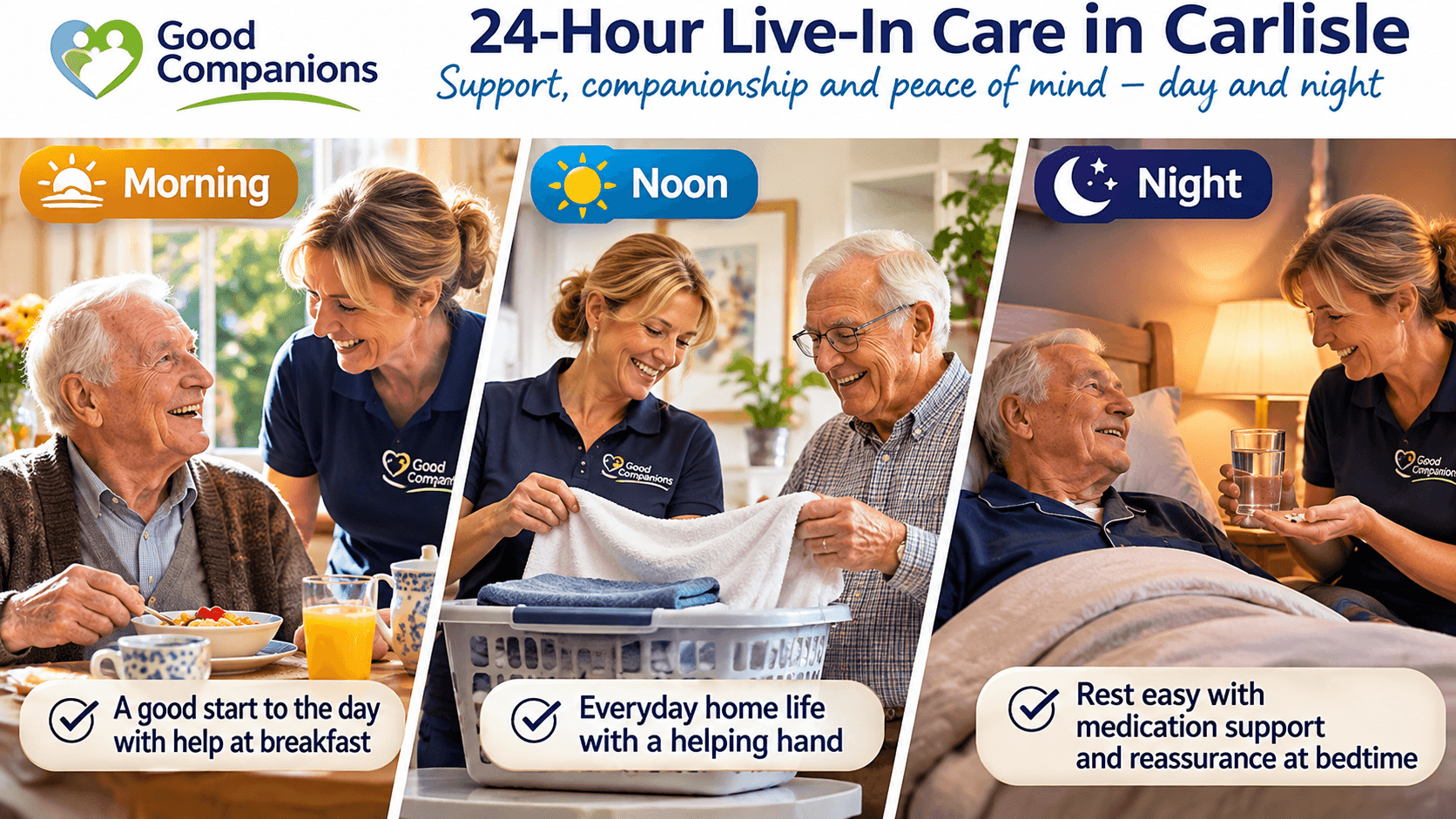
24 Hour Home Care
Discover how 24-hour live-in care can help older people in Carlisle remain independent, surrounded by the people, pets and familiar surroundings they love.
Imagine being told that your mother or father can no longer manage safely at home.
Perhaps there’s been a fall. A stay in hospital. Increasing forgetfulness. Or perhaps a husband or wife who has been providing care for years is simply exhausted.
Suddenly, the family is facing a difficult question:
“Is it time to find a care home?”
For many families in Carlisle, that feels like the natural next step.
But there’s another question worth asking first.
What if the care could come to them instead?
That’s the idea behind 24-hour live-in care—and it could make an enormous difference for someone who wants to stay in the home they’ve loved for years.
Your Care Needs May Change. Your Address Doesn’t Have To.
Think about everything that makes a house a home.
The familiar view from the kitchen window. Photographs of the grandchildren. The garden you’ve spent years tending. The dog curled up beside your favorite chair.
Perhaps it’s a family home in Stanwix, a bungalow in Dalston, a cottage near Brampton or a familiar street in Denton Holme.
These aren’t just buildings. They’re part of people’s lives.
When someone becomes frail, develops mobility difficulties or needs increasing help with everyday activities, leaving those surroundings can be a considerable emotional upheaval.
Live-in care offers a genuine alternative.
Instead of moving into residential care, a dedicated carer lives in the person’s home, providing personalised support, companionship and practical assistance.
For suitable individuals, it means life can continue in familiar surroundings, with the right help.
Meet Margaret and George: A Familiar Carlisle Story
The following is an illustrative example, not an account of actual Good Companions clients.
Margaret and George have lived in their Carlisle home for more than 40 years.
George, now in his eighties, has become less steady on his feet. Margaret has been helping him dress, preparing meals and managing their household.
Their daughter visits regularly, but she has her own family and a demanding job.
After George falls, everyone begins worrying.
Should they look for a residential care home? Would they have to move together? What would happen to their beloved dog?
Then the family discovers live-in care.
With a well-planned care arrangement, a dedicated carer could help George with personal care, prepare meals, provide companionship, and support the couple’s daily routines.
Margaret could enjoy being George’s wife again, rather than feeling responsible for every aspect of his care.
Their daughter could visit as a daughter, without every conversation becoming a discussion about medication, shopping or whether her parents are coping.
And George?
He could still sit in his favorite chair, watch the birds in the garden, and enjoy the familiar comforts of home.
Sometimes the greatest benefit of live-in care isn’t what changes. It’s what doesn’t have to change.
What Does a Live-In Carer Actually Do?
Many families understandably ask this.
A live-in carer lives in the home and provides assistance based on an individually agreed care plan.
Depending on the person’s assessed needs, that might include:
- Personal care: Help with washing, dressing, grooming and daily hygiene.
- Meals and nutrition: Preparing familiar meals and supporting healthy eating.
- Mobility: Assistance with moving safely around the home.
- Medication: Reminders or appropriate medication assistance within the agreed care plan.
- Companionship: Conversation, reassurance and shared activities.
- Household routines: Light domestic tasks, shopping and everyday organisation.
- Appointments and outings: Support with maintaining contact with the local community.
- Night-time reassurance: Agreed assistance, subject to the carer’s rest requirements and the individual’s care needs.
Importantly, 24-hour live-in care does not mean one carer works continuously, day and night.
Live-in carers need proper breaks and sleep. People requiring frequent waking-night assistance or constant supervision may need additional carers or a different care arrangement.
The objective is to provide safe, reliable and personalised support that works for everyone involved.
Five Reasons Carlisle Families Are Considering Live-In Care
1. Stay in the Home You Love
Moving into a care home can mean leaving behind familiar possessions, routines and neighbourhoods.
Live-in care may let someone stay in their own home, with support tailored to their daily life.
For people experiencing memory difficulties, familiar surroundings and routines can be particularly reassuring.
2. Keep Couples Together
When one partner needs substantially more care than the other, residential care can create difficult decisions.
Live-in care may let couples stay together, preserving the companionship and everyday routines they have shared for decades.
3. Enjoy Personalised, One-to-One Support
Residential care homes provide valuable services, often with organised activities and teams of staff.
Live-in care offers something different: support centered on the individual in their own home.
Breakfast when you prefer. Your favourite television programmes. Time in the garden. Visits from friends.
Care designed around the person, not a shared residential timetable.
4. Remain Close to Family, Friends and Pets
Whether relatives live in Carlisle itself, nearby villages or elsewhere in Cumbria, remaining at home can make it easier to maintain established family relationships.
And for many older people, keeping a much-loved pet is an important consideration.
With suitable arrangements, live-in care may make that possible.
5. Give Family Carers Some Much-Needed Relief
One of the least discussed aspects of increasing dependency is its effect on family carers.
Husbands, wives, daughters and sons often provide extraordinary support, sometimes at considerable personal cost.
Live-in care can help relieve the burden of everyday practical responsibilities.
That doesn’t mean families stop caring.
It means they can spend more time enjoying their relationships instead of being overwhelmed by the demands of caregiving.
Is Live-In Care Suitable for Someone with Dementia, Parkinson’s or Following a Stroke?
Potentially, yes.
Depending on individual needs and the support available, live-in care may be appropriate for people experiencing:
- Dementia or Alzheimer’s disease.
- Parkinson’s disease.
- Multiple sclerosis.
- Reduced mobility and frailty.
- Difficulties following a stroke.
- Other long-term conditions requiring regular daily assistance.
However, not everyone will be suited to live-in care.
Some people need specialist nursing care, multiple carers, intensive overnight supervision or facilities that cannot safely be provided in an ordinary home.
A thorough assessment is essential before deciding on the most appropriate arrangement.
How much does 24-hour live-in care cost in Carlisle?
Here’s something that surprises many families.
Live-in care may be considerably more affordable than they imagine.
<escape>Good Companions advertises live-in care from £840 per week, subject to assessment, availability and the terms of the particular care arrangement.</escape>
That’s about £120 per day.
Of course, the actual cost depends on the individual’s needs, the level of support required, and whether additional care is necessary.
Families should also remember that household expenses continue when someone remains at home.
But before assuming that residential care is the only financially realistic solution, it makes sense to compare the full costs of both options.
Ask About Our Pay the Carer Arrangement
Good Companions also offers a Pay the Carer option, designed to give suitable families another way of arranging live-in support.
This is distinct from our fully managed live-in care service.
We will explain contractual responsibilities, carer selection, cover arrangements, ongoing support, and total costs clearly before a family decides.
The important point is that families may have more choices than they initially realise.
Enquire About Live-In Care in Carlisle
Live-In Care or a Residential Care Home in Carlisle?
Both can be excellent options.
A residential care home may be preferable when someone needs a wider on-site care team, specialist facilities, or a particular level of supervision.
Live-in care may be preferable where the individual wants to remain at home a Live-In Care in Carlisle: When You Need More Help, Why Should You Have to Leave Home?nd their needs can be safely met there.
The decision should consider personal preferences, safety, care needs, family circumstances and costs.
The best choice isn’t necessarily the most familiar one. It’s the one that is right for the person receiving care.
Discover Care Compass – Your Guide to Care Choices in Cumbria
If you’re beginning to explore care for a parent, partner or loved one, it can be difficult to know where to start.
Should you arrange occasional home care visits?
Would live-in care provide enough support?
Is day care an option?
Or would residential care be more appropriate?
Good Companions has developed Care Compass, a guide to help families understand the care options available and the questions they should consider.
It’s a useful starting point whether you’re planning ahead or facing a more urgent decision.
Explore Care Compass – Your Guide to Care Choices in Cumbria
Frequently Asked Questions About Live-In Care in Carlisle
Is 24-hour live-in care available in Carlisle and surrounding villages?
Good Companions provides live-in care services across Cumbria, including the Carlisle area. Individual arrangements depend on assessment, staffing and availability.
Does the carer actually live in the house?
Yes. A live-in carer resides in the person’s home and needs suitable private accommodation and agreed rest arrangements.
Can a live-in carer support an elderly couple?
Potentially. A care assessment would establish whether one live-in carer could safely meet the agreed needs of both people or whether additional assistance would be necessary.
Is live-in care the same as having a nurse at home?
No. Live-in carers provide agreed personal and practical care. Specialist nursing procedures require appropriately qualified professionals.
What happens if the carer is ill or takes a holiday?
This depends on the service arrangement. Replacement cover, breaks, holidays and emergency arrangements should all be clarified before care begins.
Is live-in care always cheaper than residential care?
No. Costs vary, and additional care or overnight cover can increase the price. Families should compare the full cost and suitability of each option.
Before You Choose a Care Home, Find Out What’s Possible at Home
When someone you love needs more help, it’s natural to worry about the future.
But increasing care needs don’t automatically mean leaving home.
For many older people in Carlisle and the surrounding communities, live-in care offers an opportunity to preserve the familiar routines, relationships and independence that make everyday life meaningful.
The home they’ve loved for years could still be the best place for their next chapter.
Talk to Good Companions about the options available, including our fully managed live-in care service and Pay the Carer arrangement.
Because needing more care shouldn’t automatically mean leaving the home you love.
Good Companions – Caring for Cumbria.
Trusted care. Local people. A brighter tomorrow.